Course Syllabus
Introduction
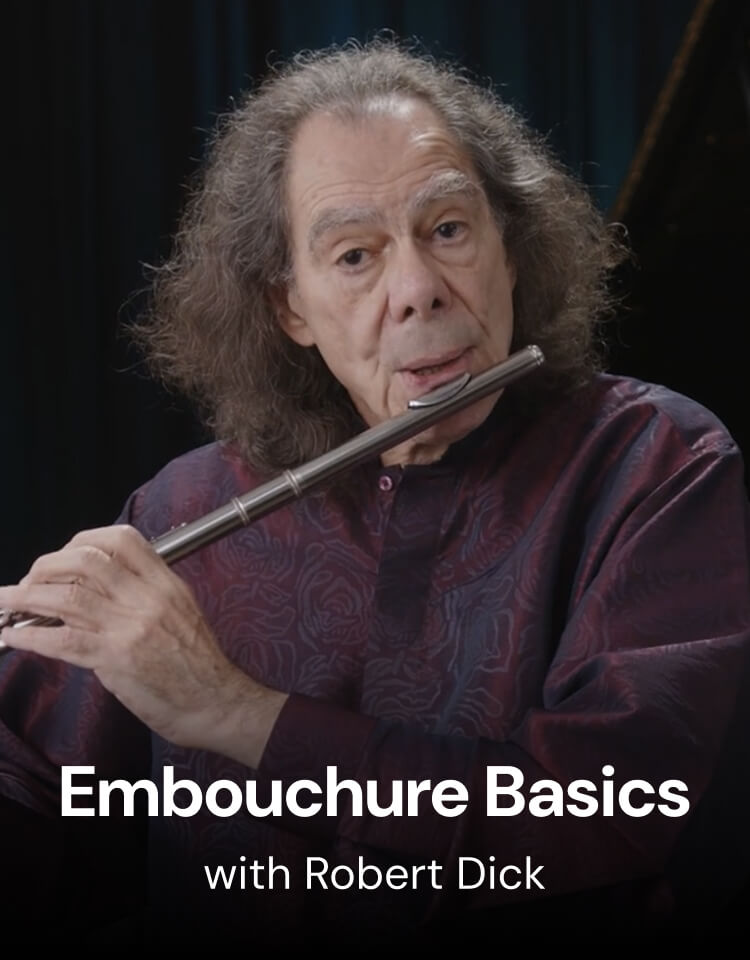
Robert Dick starts this course by speaking about the many opportunities we have as flutists to manipulate our sound and play in any genre we’d like. He talks about how versatile we can be as flutists through extended techniques.
How the Flute Works
In this lesson, Robert Dick explains how the flute works and the profound connection between the flute and the flutist. He explores how the same flutist can sound like themselves on any flute that they play.
Singing Ranges and the Flute
In this lesson, Robert Dick explores the ranges of male and female voices. He explains how the flute range and voice ranges are related to each other, and where you can start your singing and playing journey.
Throat Tuning
Robert Dick walks us through how to approach throat tuning (singing and playing) and how to practice. He talks about how to use Taffanel and Gaubert No. 1 with this technique.
Active Singing and Passive Singing
In this lesson, Robert Dick explores passive and active singing. He explains the difference between the two, and when to stop practicing if you are fatigued.
Dynamics and Range
In this lesson, Robert Dick talks about the range of the voice and the instrument. He talks about how it can be difficult to play in the high register while singing, and how to approach this issue.
Throat Tuning in Practice
Robert Dick walks us through how he implements throat tuning into etudes and pieces, walking us through how he would apply this to a Karg-Elert Caprice and Chaminade’s Concertino.
The Solution to Bad Sound Days
In this lesson, Robert Dick offers the solution to “Bad” sound days. We’ve all had them, and throat tuning exercises might just be the quick fix we’ve all been looking for!